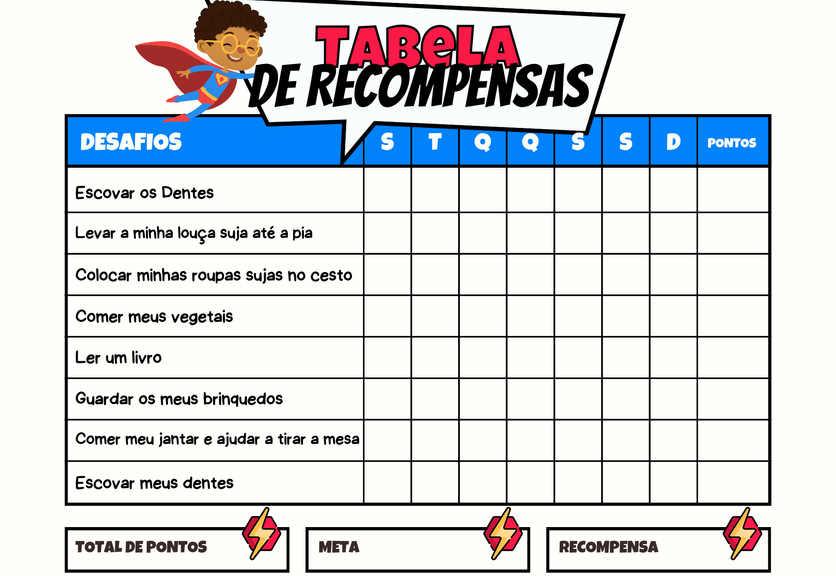
Kids' Chore Chart: free printable templates

A good chore chart transforms life at home: kids learn responsibility, gain autonomy, and adults stop repeating “go brush your teeth” five times a day. Below you'll find ready-made templates by age, a step-by-step to build your own, and an editable online version.

How to make a chore chart in 5 steps

  1. Pick 3 to 7 tasks

    Less is more. Start with a small set of tasks the child can succeed at every day — the goal is momentum, not frustration.

  2. Print or customize a template

    Download one of the PDF templates below, or build your own in the online tool with your child's name and tasks.

  3. Agree on the reward up front

    Decide together what a star is worth: a weekend outing, movie pick, or a simple surprise. Buy-in matters.

  4. Put it somewhere visible

    Fridge, bedroom door or wall. The chart needs to be at the child's eye level so they can mark it themselves.

  5. Review it every week

    Talk it through on Sunday: what worked, what needs to change. The chart evolves as the child grows.

Templates by age group

Each age deserves a different kind of chart. Download the PDF that fits your child — they're all free and ready to print on A4/Letter.

Example of Picture Chore Chart (Preschool)
ages 2-4

Picture Chore Chart (Preschool)

For kids who can't read yet. Use large illustrations and just a few tasks (3 to 5). Mark with stickers or stars.

Suggested tasks:

  • Brush teeth
  • Put toys away
  • Eat the fruit at snack time
  • Get into pajamas alone
Download PDF
Example of Weekly Illustrated Chore Chart
ages 5-7

Weekly Illustrated Chore Chart

For the early-reading years. Kids understand the days of the week and love ticking off each win. Add simple school tasks.

Suggested tasks:

  • Make the bed
  • Do homework
  • Help set the table
  • Take a bath without complaining
  • Put backpack away
Download PDF
Example of Chores and Responsibilities Chart
ages 8-12

Chores and Responsibilities Chart

For elementary school kids. They can handle household tasks with more autonomy. Pair points with a small allowance.

Suggested tasks:

  • Study 30 minutes a day
  • Wash snack dishes
  • Take care of the pet (food/water)
  • Tidy up the room
  • Sort out laundry
Download PDF

Prefer to build your own online?

Use our free tool to build a customized chore chart with your child's name, the tasks that fit your home, and the days of the week. Edit, print, and stick it on the fridge.

Tips to make the chart actually work

Start small

Three tasks for a week is enough. Add more only after those become habits.

Reward effort, not perfection

Star earned even if teeth were brushed a bit crookedly? Yes. The chart rewards trying.

Never remove a star as punishment

If the child didn't complete the task, they simply don't earn the star. Taking one away builds frustration and pushes kids to quit.

Choose the reward with your child

A reward you impose demotivates. Ask: “What would you like to earn if you complete the week?”

Frequently asked questions

What's the difference between a routine chart and a chore chart?

A routine chart shows the order of the day (wake up, school, dinner). A chore chart focuses on specific responsibilities that earn a star when completed.

From what age can I use a chore chart?

From age 2-3, with large pictures. From age 5 onward you can include words and more elaborate tasks like homework.

Can I use an allowance as the reward?

Yes, especially from age 7-8. Assign a small monetary value to each star — and use the allowance calculator to set a fair amount.

My child lost interest in the chart. What now?

That's normal: after 4-6 weeks a chart needs novelty. Change the artwork, swap the tasks, raise the final reward, or take a 2-week break.

Veja também

Recursos relacionados

Continue explorando temas que conversam com este conteúdo.

Receba atividades novas toda semana.

Sem spam. Só ideias boas para você e seu pequeno.